Identify radiation patterns using absorbers
Predict and measure how three radioactive sources respond to paper, aluminium and lead.
- Physics
- Upper-secondary physics; approximately ages 16-18
- 85 min

University of Queensland
Examine the intensity of radiation over distance, and demonstrate the effect of the inverse square law
Laboratory information
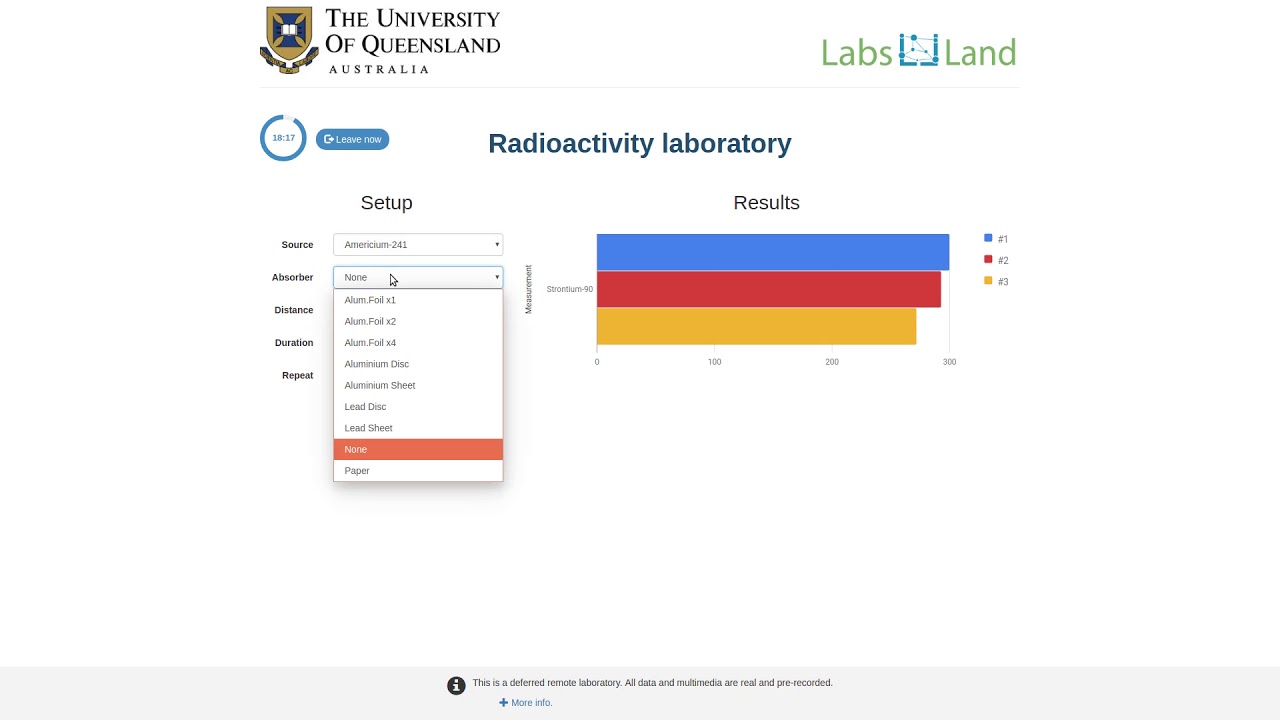
The setup, useful for schools and universities, includes a Geiger counter that can measure the number of detected particle collisions. The user can choose among different radioactive sources, as well as an absorber to put between the radioactive source and the probe. Additionally, other parameters that users can vary are the distance and number of tests. This allows for a wide range of experiments and learning opportunities.
Radioactivity is the process in which an atomic nucleus loses energy by emitting particles and radiation. This can occur naturally in certain elements, or artificially through the use of nuclear reactions. In the context of physics at schools and universities, studying radioactivity can provide valuable insights into the fundamental nature of matter and the laws of physics.
One common experiment in this area is the measurement of radioactivity using a Geiger counter. This instrument is able to detect the emission of particles from a radioactive source, allowing students to understand the basic principles of radiation and its effects on matter. By varying the type of radioactive source, the distance between the source and the detector, and the type of absorber material placed between the two, students can explore a wide range of phenomena and gain a deeper understanding of the underlying principles.
In addition to its educational value, studying radioactivity also has practical applications in fields such as medicine, energy production, and environmental protection. As such, it is an important topic for students to learn about, both for its intrinsic interest and for the many real-world applications it has.
One of the most common applications of radioactivity is in the field of medicine. Radioactive isotopes are used in medical imaging techniques such as PET and SPECT scans, which allow doctors to see inside the body and diagnose diseases. Radioactive isotopes are also used in cancer treatments, such as radiotherapy, where they are used to kill cancer cells.
Radioactivity is also used in industries such as oil and gas exploration, where it is used to measure the permeability of rock formations and the flow of fluids through them. Radioactive isotopes are also used in smoke detectors and in the production of luminous watches and instruments.
Overall, radioactivity has a wide range of applications in fields such as medicine, industry, and even everyday consumer products. It continues to be an important area of study in physics and other sciences, and its uses continue to expand as new technologies are developed.
The use of a geiger counter in a radioactivity experiment allows for a wide range of possibilities. By varying the radiation emitters and absorbers, students can observe the effects of different sources and materials on the detected particle collisions. This can help students understand the properties of radioactivity and the behavior of different particles.
Additionally, experiments involving the determination of the type of particle being radiated can be conducted by observing whether the particle is absorbed or not. By placing different absorbers between the source and the probe, students can determine the properties of the emitted particles and gain a deeper understanding of radioactivity.
Lastly, experiments involving the determination of the geometric form of radioactivity emission can also be conducted using a geiger counter. By carefully measuring the detected particle collisions at different distances, students can gain insights into the spatial distribution of radioactivity. This can help students understand the fundamental principles of radioactivity and its applications in the real world.
Potential objectives of activities conducted with the laboratory are the following:
What students do
Ready lesson plans
Preview classroom-ready activities that guide students through the real laboratory.
Predict and measure how three radioactive sources respond to paper, aluminium and lead.
Measure how detector counts change with distance and test an inverse-square model.
Students use repeated measurements from the remote lab to investigate how the detected count changes as distance increases and whether a straight line describes the pattern well.
Video
Available experiments
Use different components (Strontium-90, Americium-241, Cobolt-60) and absorbers.
Teaching resources
Radioactivity
Open resourceWe will study radioactivity and the particles that support it. We will bombard different materials with radioactivity (alpha, beta and gamma particles).
Open resourceWe will study the linear or non-linear behaviour of natural phenomena.
Open resourceIn activity you will study how different materials emit radioactivity and which are the differences between the particles emitted.
There are many types of radiation with different intensity; we will observe how each type of radiation is more or less effectively blocked by different materials. Then, we will represent graphically and numerically the results of the experiment, and propose possible answers to questions or situations raised.