Summary
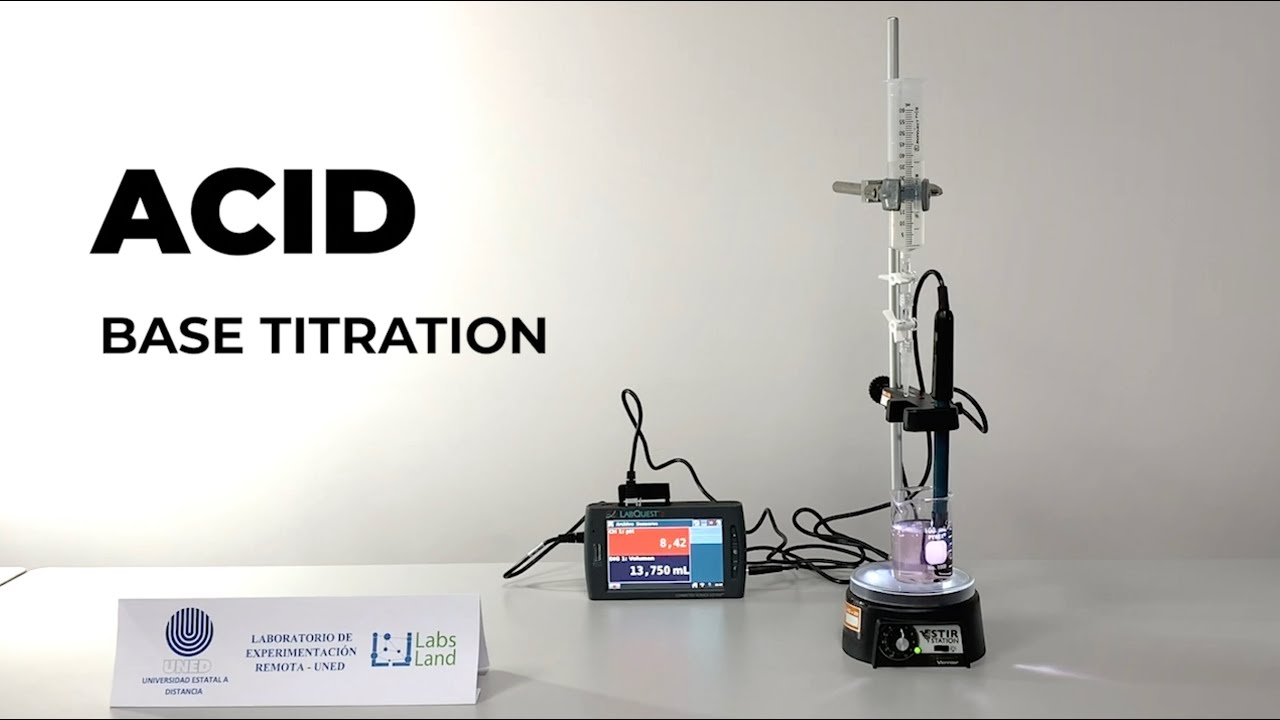
Perform an acid-base titration to determine the concentration of an unknown citric acid solution using a sodium hydroxide titrant. A digital pH sensor is always available and a phenolphthalein indicator has been applied to the unknown solution so that both a potentiometric and colorimetric approach can be used. A real-time plot is also available.
Acid-Base Titration
Titrations are a volumetric method that is based on measuring the amount of a known-concentration reactive (known as a primary standard) that is consumed by an unknown-concentration sample known as analyte.
The titration is conducted by adding the titrant to the analyte using a burette, so as to obtain a chemically-equivalent substance between the titrant and the analyte. This is known as the "equivalence point" and it is a theoretical value that cannot be experimentally determined.
The experimental estimation of this point is obtained through an approximation known as "final point". This is determined through a physical change. In that case, the change in color of the solution is achieved after adding an indicator substance: a substance that changes color in certain ranges of pH.
For the acid-base titration we use a phenolphthalein indicator that becomes a light pink after a pH of around 8.4, which is a value that is very close to the equivalence point in the most common acid-base titrations.
Colorimetric vs Potentiometric approaches
The colorimetric approach relies on the color change provided by the phenolphthalein indicator. The potentiometric approach relies instead on the pH raise as measured by the digital sensor. In this version of the acid-base titration laboratory both approaches can be used. The digital sensor is always available and cannot be hidden.
Differences with the Acid-Base Titration II laboratory
In this version of the laboratory (Acid-Base Titration I) you can perform the acid-base titration for an unknown citric acid solution. In the other version of the laboratory (see Acid-Base Titration II) you can perform the acid-base titration for an acetic acid solution instead.
This version of the laboratory emphasizes the calculations but does not have visual burette measurements among its learning objectives. The other version of the laboratory (see Acid-Base Titration II) emphasizes visual measurements, and students must learn to read the meniscus of the burette properly.
Also, in this version there is a single experience that can be used for both the colorimetric and potentiometric approaches. In the other version of the laboratory (see Acid-Base Titration II) there are two different configurations available, in one of which the digital sensor is hidden so that students may only rely on the color change.