Digitrainer
Open Digital Trainer through LabsLand.

Remote Hub Lab, University of Washington
Game-like activity for an introduction to digital logic and truth tables, designed to be simple, quick and engaging.
Laboratory information
The Digital Trainer laboratory is designed towards students that are starting with digital logic, truth tables and Boole's Algebra.
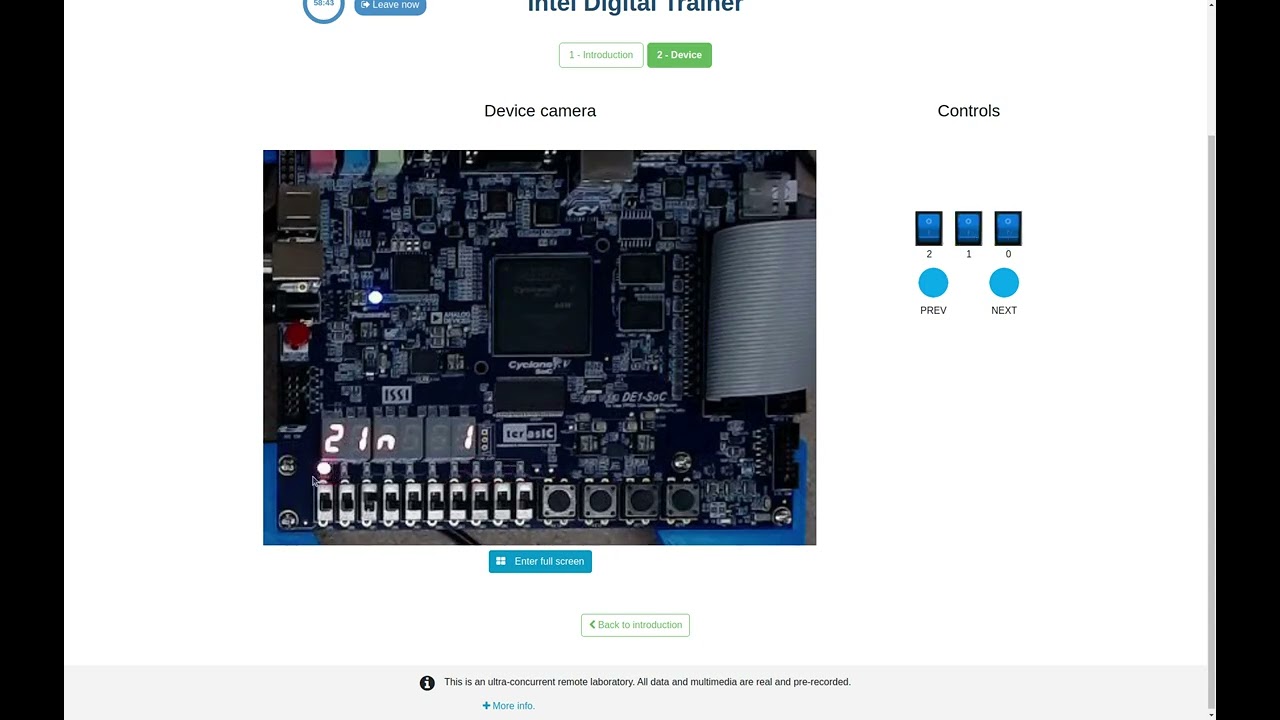
During the activity, the student sees an Intel FPGA that implements a series of simple truth tables. The student can interact with the FPGA devices to vary the inputs to the system through switches, and observe the outputs through LEDs. The challenge is to determine which logical operator the FPGA implements in each case (e.g. AND, NAND...).
The activity is designed to be relatively simple and straightforward, but at the same time to be engaging for the students. It is designed in a game-like style, and it is based in real hardware (FPGAs). That way, it is not only useful to introduce and obtain familiarity with digital logic, but also it allows students to start seeing the future uses of that knowledge, interacting in a superficial way with FPGA devices, of the same kind that are used in industry.
Interaction with the FPGA devices does not add complexity, since students don't need to program them; they already implement a black box logic (which is precisely the point of the activity).
The laboratory is originally based in an activity that Intel Corporation frequently conducts in its seminars, both hands-on and remote, using their Intel DE1-SoC, Intel DE2-115, or other types of FPGAs.
What students do
Video
Available experiments
Open Digital Trainer through LabsLand.
Teaching resources
User's guide and test related to the exercises programmed in the trainer.
10 exercises for the introduction to digital logic.
The objective is to determine the logic function associated with each exercise by seeing how the output changes as a function of the inputs.
80+ pages of contents on how to use the FPGA laboratory, Boole Designer, Digital Trainer
Open resource