Summary
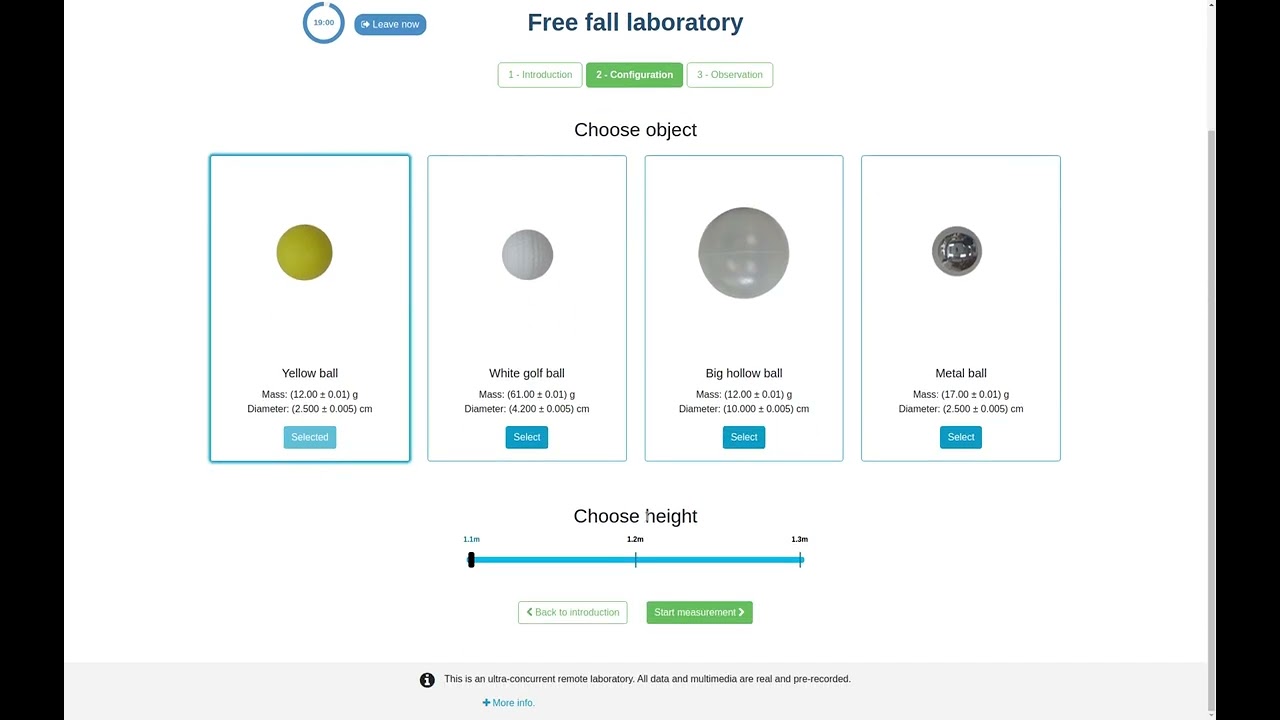
The remote laboratory offers a convenient way for schools and universities to conduct experiments on gravity and energy conservation. Students can choose from a variety of objects with different masses and release them using an electric switch. A receiving device will measure the time it takes for the object to fall, allowing students to experimentally calculate gravity and conduct other experiments related to free-falling objects. The laboratory offers activities for varying levels, making it suitable for students of all abilities. By using the remote laboratory, students can gain a deeper understanding of these fundamental concepts in physics.
Free-fall
Free-fall is a phenomenon that occurs when an object falls under the influence of gravity alone. This can be observed by dropping an object from a certain height and watching it accelerate towards the ground at a constant rate. In schools and universities, free-fall experiments are commonly used to help students understand and explore the fundamental concepts of gravity and energy conservation. These experiments typically involve releasing an object from a known height and using a receiving device to measure its time of fall, allowing students to calculate the acceleration due to gravity and conduct other experiments related to free-falling objects. By conducting these experiments, students can gain a deeper understanding of the physical principles that govern free-fall and how they apply to real-world situations.
In a free-fall experiment, students can carefully measure the initial height of the falling object and the time it takes to reach the ground, allowing them to calculate the acceleration due to gravity. Students can also experiment with different objects of varying masses to see how the acceleration due to gravity changes based on the mass of the object. In addition to helping students understand the basic principles of gravity and energy conservation, free-fall experiments can also be used to explore more advanced concepts in physics. For example, students can experiment with objects that have different shapes and densities to see how these factors affect the rate of free-fall. They can also use the results of their experiments to make predictions about the motion of objects in real-world situations, such as the motion of a skydiver or a satellite in orbit around the Earth. Overall, free-fall experiments are an engaging and effective way for students to learn about the fundamental principles of physics.
Incorporation in Physics & Physical Science courses
Free fall experiments are typically included in courses at both the university and school level that focus on physics and physical science. At the university level, free fall experiments are often included in introductory physics courses, as well as in more advanced courses that focus on mechanics, gravitation, and other related topics. At the school level, free fall experiments are often included in middle and high school physical science courses, where they can help students develop an understanding of key physical science concepts and principles, such as forces, motion, energy, and momentum. These experiments may also be included in more advanced courses, such as high school physics or college-level physics courses for non-physics majors.
Typical learning objectives
The typical learning objectives of a free-fall laboratory for the school and university level are as follows:
- Develop an understanding of key physical science concepts and principles, such as forces, motion, energy, and momentum. Free fall is a key concept in the study of motion and the effects of gravity, and is related to these physical science concepts and principles.
- Apply physical science concepts and principles to real-world situations using laboratory equipment and facilities. The concept of free fall is relevant to a wide range of real-world situations, and can be studied using laboratory equipment and facilities.
- Gain hands-on experience with conducting experiments and analyzing data, using specialized equipment and facilities. Free-fall experiments can provide students with hands-on experience with conducting experiments and analyzing data.
- Learn how to design and conduct experiments using laboratory equipment and facilities. Free-fall experiments can help students learn how to design and conduct experiments.
- Learn how to control variables and collect data, using specialized equipment and facilities. In free-fall experiments, students can learn how to control variables and collect data.
- Use data collected to draw conclusions and make predictions. Data collected from free-fall experiments can be used to draw conclusions and make predictions about the effects of gravity on the motion of objects.
- Develop critical thinking and problem-solving skills through the use of laboratory equipment and facilities. Free-fall experiments can help students develop critical thinking and problem-solving skills.
- Appreciate the importance of scientific inquiry and the scientific method, and the role of technology in advancing scientific knowledge. Free-fall experiments can help students appreciate the importance of scientific inquiry and the role of technology in advancing scientific knowledge.