
Flowloop
Open Flowloop through LabsLand.

TU Clausthal
Visualize flow patterns of multi-phase systems that develop in production tubing
Laboratory information
The Multi-Phase Flowloop laboratory lets you carry out experiments to visualize flow patterns of multi-phase systems that develop in production tubing in possible real-life scenarios. Through variation of the water flowrate and the angle of the tubing itself, you can appreciate the forming of different flow patterns or “cuttings” depending on the chosen values.
Multi-phase systems are found in various industrial scenarios, not being an exception the oil and gas industry. The prediction and determination of the flow pattern in the production tubing is of great importance since this is directly involved with the optimization of the production itself.
Mixtures of hydrocarbons, water, sediments and gases found in reservoirs manifest different behaviors during their transportation to the ground’s surface. Predicting such behaviors enable a better understanding for adequate choice of pumping machinery and pipeline setups for a successful transport to their final processing facility. The Multi-Phase Flowloop test unit helps achieving a better predictiveness of how multi-phase systems behave in real life for further investigation. This enables the user a better comprehension and visualization of how multi-phase transportations react under variable production rates and mixture proportions.
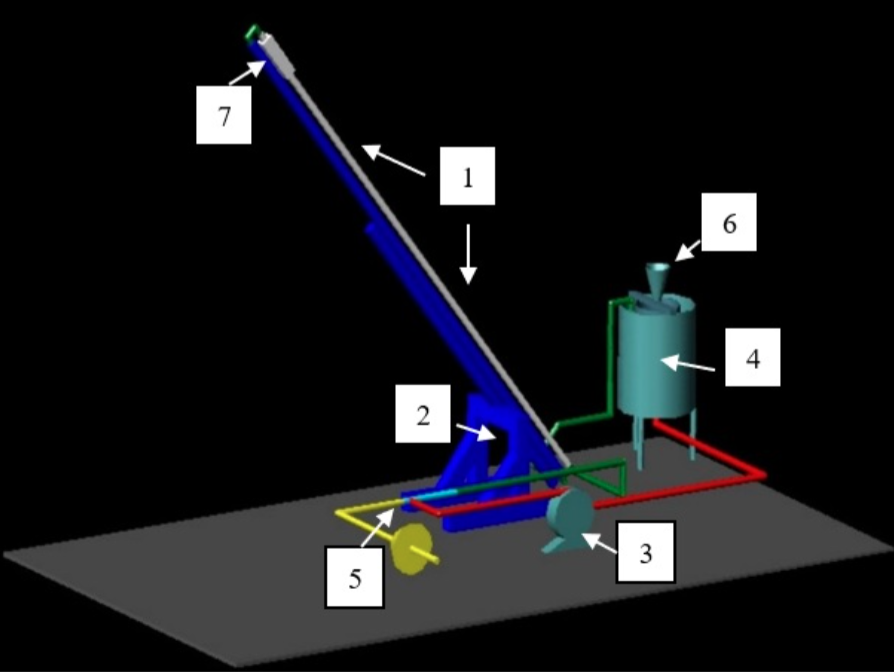
The Multi-Phase Flowloop laboratory lets you carry out experiments to visualize flow patterns of multi-phase systems that develop in production tubing in possible real-life scenarios. Through variation of the water flowrate and the angle of the tubing itself, you can appreciate the forming of different flow-patterns or “cuttings” depending on the chosen values.
What students do
Video
Available experiments
Open Flowloop through LabsLand.