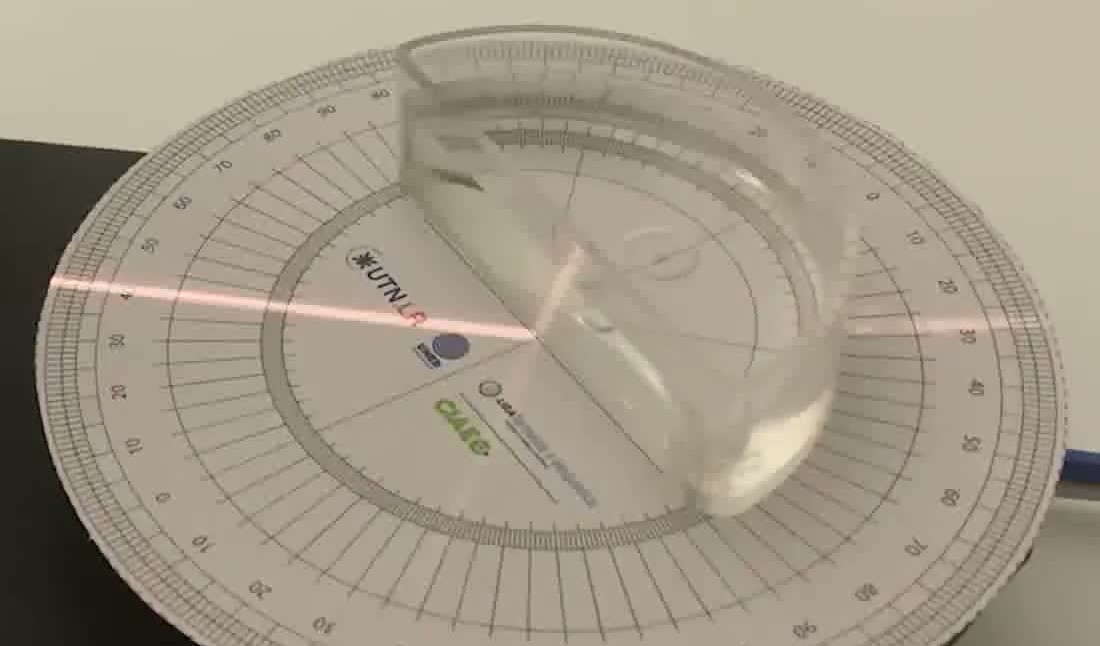
A laser hits the flat side of a container of water. Look down at the setup and you can see the beam change direction as it enters. How much does it bend? With a protractor and four readings from a remote lab at UNED Costa Rica, we can work out the refractive index of water.
Where do you measure the angles from?
Find the point where the laser crosses the flat face of the container. Draw a line through that point at right angles to the face. This line is the normal. Measure the angle of incidence i from the normal to the incoming ray in air. Then measure the angle of refraction r from the normal to the ray in the water.
Here’s a quick check. If you aim the laser straight at the face, both angles should read 0°. A reading of 90° means you’ve started from the surface.
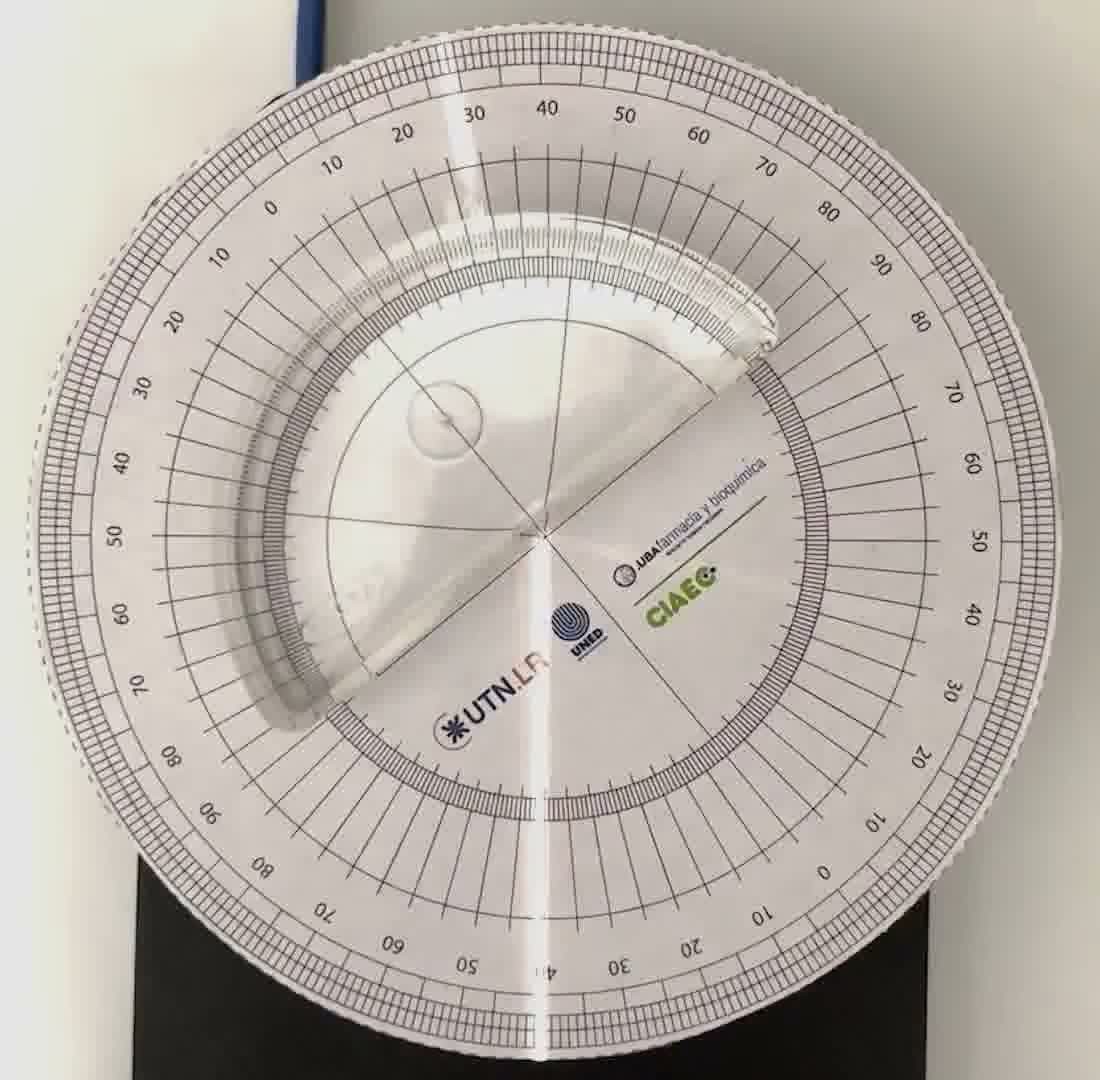
Four angle readings from the experiment
We keep the same container of water and change the angle of the incoming beam. These are the reference readings for the classroom activity, rounded to the nearest degree. Depending on where you judge the middle of the beam to be, your last degree might come out differently.
| i (°) | r (°) | sin i / sin r |
|---|---|---|
| 20 | 15 | 1.32 |
| 40 | 29 | 1.33 |
| 60 | 41 | 1.32 |
| 80 | 48 | 1.33 |
In every row, the ray in the water lies closer to the normal. Divide the angles and the answer changes from one row to the next. Divide their sines and you get almost the same number each time.
How to find the refractive index of water
Snell’s law gives nair sin i = nwater sin r. Air has a refractive index very close to 1, so we can divide the two sines to estimate the index of water. Set your calculator to degrees and try the second row.
nwater ≈ sin(40°) / sin(29°) ≈ 0.643 / 0.485 ≈ 1.33.
To use all four readings, plot sin r on the horizontal axis and sin i on the vertical axis. The points sit near a straight line through the origin. Its slope, about 1.32 for these readings, gives another estimate of the same index.
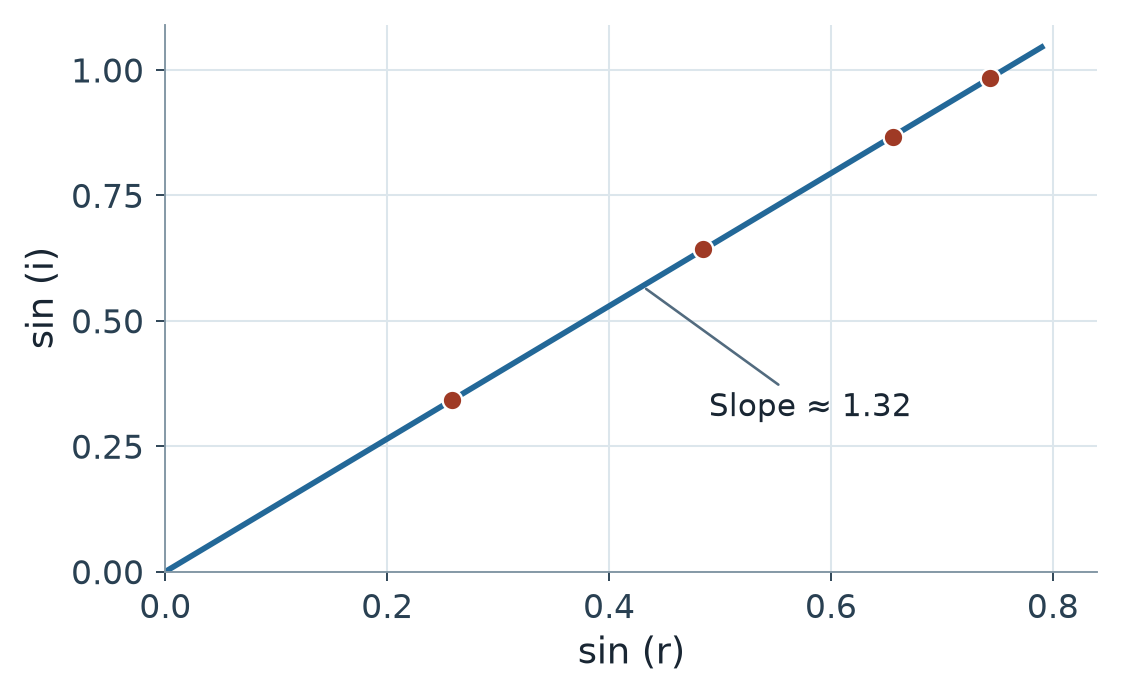
Try predicting a fifth angle
If the incident angle is 50°, will the refracted angle be closer to 30° or to 50°? Use the index you just worked out to make a prediction, then see roughly where the beam should cross the scale.
The Snell’s law activity in LabsLand Teach takes this experiment into the classroom. The photos are from the UNED Costa Rica refraction lab.
This post is also available in Español.